Scotch Eggs
An egg wrapped in sausage, breaded and fried. Learn its disputed origin and the trick to keeping the yolk creamy inside the crust.
Free, no account needed.
Did you cook it? Add your photo
So it lives in your cookbook with your story, not mine.
Add my photo
35 min
Británica / British
4 servings
The story behind
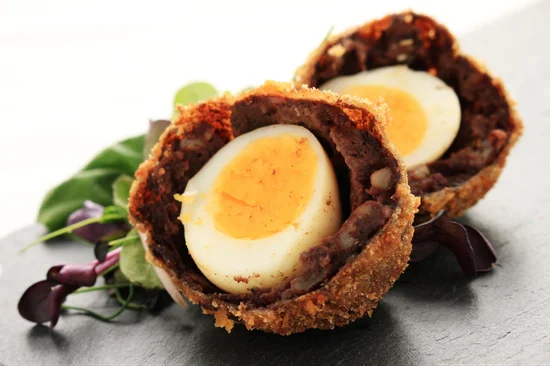
A whole egg wrapped in sausage meat, breaded and fried to a deep gold: that layered contrast is the signature of the Scotch egg. Despite the name, its origin is contested and rarely points to Scotland at all. The most cited story credits the London shop Fortnum & Mason around 1738, said to have created them as a portable snack for travelers; other theories link them to Indian meat-wrapped dishes that arrived through British trade. Whatever the truth, they are now a fixture of UK pubs and picnics. The decisive technique is the egg's doneness: many prefer a soft set with the yolk still creamy, which means boiling the egg just so and chilling it well before wrapping, so it does not overcook in the fryer. The sausage meat has to seal smoothly all the way around with no gaps, and the triple coat of flour, beaten egg and breadcrumbs guarantees a crisp shell that won't slide off. They are eaten cold or warm, whole or halved to show off the egg's core, almost always with a dab of English mustard alongside.
Instructions
-
1Boil eggs for 6 minutes for a soft yolk, then chill in ice water and peel.
-
2Divide sausage meat into equal portions and flatten each on cling film.
-
3Place an egg in the center of the meat and carefully wrap it completely until fully encased.
-
4Coat each meat-wrapped egg in flour, then beaten egg, and finally breadcrumbs.
-
5Deep fry in hot oil at 170°C for 8-10 minutes until golden brown and the meat is fully cooked.
Share this recipe
Rate this recipe
Sign in to the app to rate
You might also like
🍊
Save this recipe to your Zest
Add photos when you cook it, write your story, and share it with a Moment Card.
Create my free account