Cornstarch Alfajores
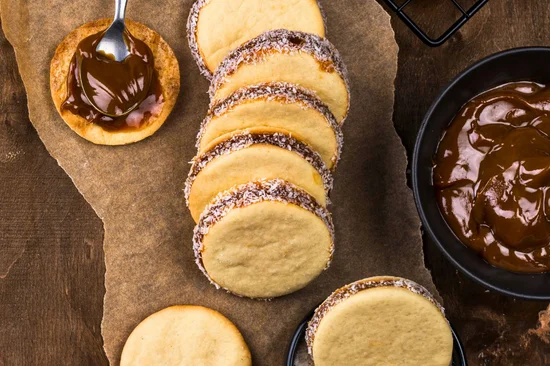
Crumbling discs, dulce de leche and coconut: the River Plate alfajor. The secret is gluten-free cornstarch, giving that melt-in-the-mouth crumb.
Free, no account needed.
Did you cook it? Add your photo
So it lives in your cookbook with your story, not mine.
Add my photo
45 min
Medium
Rioplatense / Latinoamericana
12 servings
The story behind
Oddly enough, this thoroughly River Plate sweet carries an Arabic name: "alfajor" descends from the Arabic al-hasú, "the filling," a legacy of Spain's Moorish centuries that crossed the Atlantic with colonization. In Argentina and Uruguay it evolved into this unmistakable form — two pale, crumbling discs joined by dulce de leche and rimmed in shredded coconut. The texture's secret lies in an inverted flour ratio, with more cornstarch than wheat flour. Cornstarch has no gluten, so it lends structure without elasticity, producing that sandy crumb that dissolves on the tongue instead of a firm cookie. That's why the dough is handled as little as possible: overworking would develop what little gluten the wheat flour has and cost you the fragility. A pastry-grade dulce de leche, thicker than the everyday kind, holds the discs together without oozing, and the shredded coconut clings to the moist rim of exposed filling. This is the sweet of afternoon merienda, kitchen-drawer treats and corner kiosks across the region. Try them with coffee or mate; they collapse at the first bite, leaving the caramel at the center.
Instructions
-
1Cream butter with sugar, add yolks and dry ingredients until a smooth dough forms.
-
2Roll out the dough and cut into circles; bake at 180°C (350°F) until barely golden.
-
3Once cooled, sandwich two discs together with a thick layer of dulce de leche.
-
4Press gently so the filling peeks out and roll the edges in shredded coconut.
-
5Present on parchment paper to emphasize their artisanal and professional finish.
Share this recipe
Rate this recipe
Sign in to the app to rate
You might also like
🍊
Save this recipe to your Zest
Add photos when you cook it, write your story, and share it with a Moment Card.
Create my free account